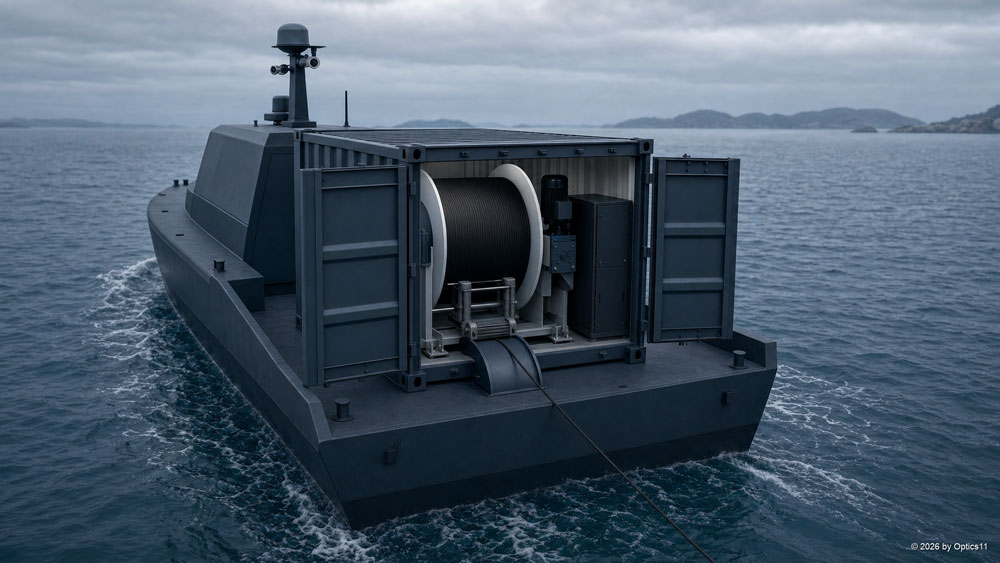
Amsterdam, Netherlands: OPTICS11, the world leader in passive fibre optic acoustic subsea sensing, today announces a major expansion of its OptiArray product line. The Dutch Ministry of Defence has ordered its fully operational containerised towed array systems that can be rapidly deployed onto a wide variety of vessels of opportunity. This allows advanced anti-submarine (both crewed and unmanned) sensing technology to be deployed quickly, simply and cost-effectively.
Towed array systems have traditionally been integrated into a limited number of specialised naval vessels. By adapting OptiArray into a portable, containerised system, OPTICS11 allows navies to gain advanced sonar sensing capability across a much broader range of existing vessels. Crewed and uncrewed maritime platforms can be retrofitted according to operational need. Wider sensing availability becomes a strategic advantage as drone use expands exponentially.
The Dutch Ministry of Defence has ordered the first systems under the ASWINABO, or Anti-Submarine Warfare In A Box, program, which is intended to strengthen the readiness and self-sufficiency of the Royal Netherlands Navy. The order continues the adaptation of OPTICS11’s technology by the Royal Netherlands Navy.
Autonomous underwater vehicles are ever more available and destructive, while the subsea and maritime infrastructure has become an increasingly attractive target for espionage, sabotage and hybrid warfare. Northern Europe has had to contend with Russian shadow fleets and spy ships testing the limits of territorial waters to gather information. Sophisticated underwater monitoring is becoming a critical component of national security.
OptiArray, the next-generation fibre-optic-based towed array, is built using world-leading fibre optic hydrophone technology to deliver exceptional underwater detection for anti-submarine warfare and maritime surveillance. Unlike conventional electrical towed arrays, which rely on powered electronics throughout the sensing chain, generate electrical noise and are susceptible to electromagnetic interference, OptiArray is passive and so remains acoustically silent while capturing significantly richer acoustic information. The result is earlier detection, more accurate target classification and greater operational confidence for decision making.
Alongside delivery of the operational systems, the project will establish the production, integration and validation capability required to support future deployment at scale. Investment in manufacturing readiness, supply chain resilience and production infrastructure will also help mature technologies supporting future programmes, while strengthening the Netherlands’ ability to rapidly field advanced underwater sensing capabilities as operational requirements continue to evolve.
Paul Heiden, CEO of OPTICS11, said: “The underwater threat environment is evolving rapidly, but advanced threat sensing has traditionally been confined to a small number of specialist naval platforms. By containerising OptiArray, we’re making world-class detection faster, more flexible and cheaper. We want to set the standard for unmanned underwater and above-water drones, as our technology is a perfect fit for doing this: light, small, highly sensitive and very accurate. As critical subsea infrastructure becomes increasingly contested, prevention starts with detection.”
Lucas Leppink, Captain RNLN (OF-5), Head of the Maritime Systems Department, COMMIT (NL-MoD), said: “With ASWINABO, the Royal Netherlands Navy will be able to equip its surface ships, unmanned surface vessels and any other vessel of opportunity with underwater surveillance capability, a game‑changer for maritime security operations and undersea infrastructure protection.”
ENDS
About OPTICS11
Founded in 2011, OPTICS11 is a Dutch deep technology company and the developer of the world’s most sensitive passive fibre optic sensing array, capable of detecting and classifying underwater targets, even up to 100 kilometres from the shoreline. Led by CEO Paul Heiden, the Company has transformed more than a decade of pioneering scientific research, following its spin-out from Vrije Universiteit Amsterdam, into operational products that help governments, navies, utilities and infrastructure operators detect threats earlier, strengthen resilience and make better decisions. Its pioneering technology has been selected by the Dutch Government to support the next generation of maritime surveillance and critical infrastructure protection.
Its portfolio includes OptiBarrier, a static passive fibre optic sensing seabed-placed system providing persistent, long-range protection for ports, offshore wind farms, subsea cables and other critical maritime infrastructure; OptiArray, a next-generation fibre optic towed array delivering advanced underwater awareness for naval platforms; and OptiFinder, a fibre optic monitoring solution that detects the earliest signs of failure or partial discharge within high-voltage electrical infrastructure.
By replacing conventional electrical sensing with passive fibre optic technology, OPTICS11 delivers richer data, earlier detection and greater operational confidence across some of the world’s most demanding environments. As autonomous threats become more sophisticated and critical infrastructure becomes increasingly contested, the Company is helping redefine how nations monitor, protect and secure the systems society depends upon.
About OptiArray
OptiArray is OPTICS11’s next-generation passive towed array, built using the Company’s world-leading fibre optic hydrophone technology to deliver exceptional underwater awareness for anti-submarine warfare and maritime surveillance. Designed for anti-submarine warfare, maritime surveillance and critical infrastructure protection, OptiArray replaces conventional electrical sensing with passive fibre
optic technology, delivering significantly richer acoustic data, earlier detection and more accurate target classification while remaining silent and immune to electromagnetic interference.
Engineered for deployment across both dedicated naval platforms and vessels of opportunity, OptiArray enables governments and naval operators to rapidly expand underwater sensing capability without relying solely on specialist warships. As autonomous underwater threats become more sophisticated and critical subsea infrastructure becomes increasingly contested, OptiArray is helping redefine how nations monitor, protect and secure the underwater domain.