The Transformer Decision Gap: When to Keep Operating, Monitor or Intervene

Screenshot 2026-09-30 151247

For a power generator, a transformer alert stops being “just a maintenance task” when it
threatens generation capacity. A critical generator transformer with little or no redundancy can escalate very quickly into lost output, emergency costs and safety exposure.

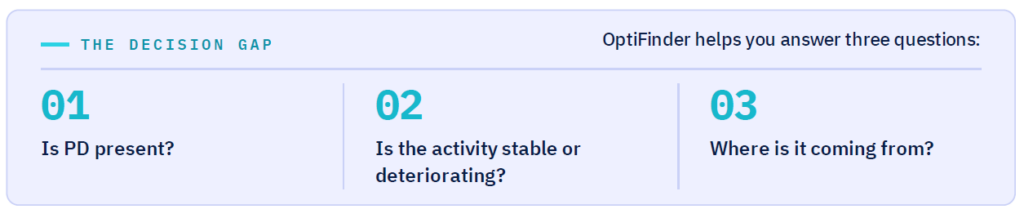
The challenge is not simply knowing something may be wrong, it’s understanding the impact:

  1. Is the condition stable or deteriorating?
  2. Exactly where is it?
  3. Can the generator keep operating until the next planned outage?

This is where continuous partial discharge (PD) monitoring can improve decision making. 

When uncertainty becomes operational risk

Age alone does not determine which transformers deserve continuous monitoring. The strongest business case is usually built around criticality: a critical plant transformer whose failure would take a generating unit offline, has a long replacement lead time, or cannot be backed up easily.

The need becomes more urgent when dissolved gas analysis (DGA), a spot test, or another diagnostic has already raised concern. An elevated or increasing hydrogen level in DGA, particularly when seen together with other fault gases, can indicate possible PD-related activity and justify closer investigation. The trend over time is generally more informative than a single measurement. Those methods are valuable, but they may not show whether PD is continuous or intermittent, how it is developing, or where the activity is located. Without that information, teams are left weighing the cost of acting too early against the risk of waiting too long.

From warning to action

Optics11’s OptiFinder is designed to provide detailed data that complements DGA and fills
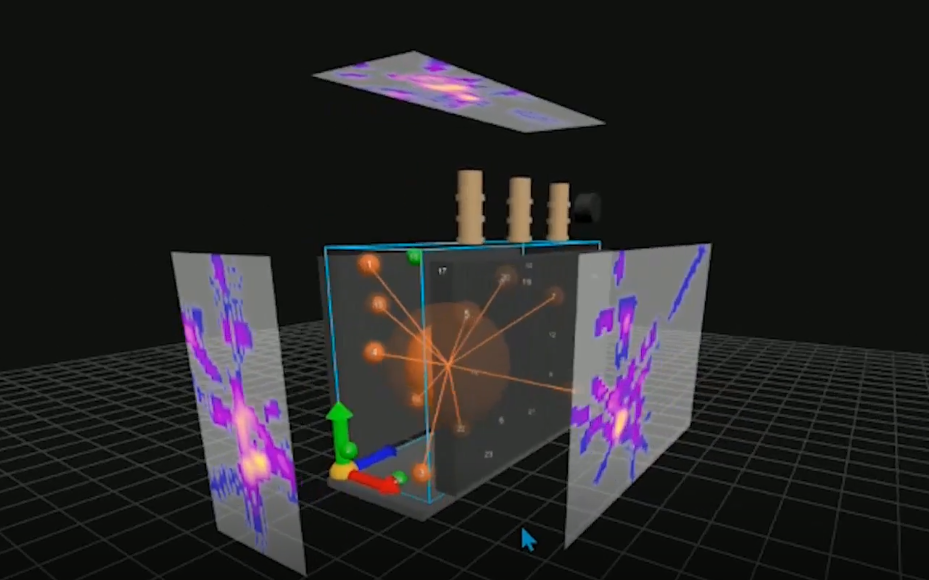
the gap needed to make informed decisions. It uses fiber-optic acoustic sensing to monitor PD activity over time and localize the source within 15 cm accuracy.

For asset managers, that turns a general warning into evidence for a practical operating decision: continue operating under closer monitoring, prepare a focused intervention for a scheduled outage, or act sooner because the condition is developing.

In one recent power-generation case, the customer needed more accurate PD localization than its existing tool could provide. The OptiFinder solution with 32 high-sensitivity sensor placements and our noise-filtering algorithms gave the team a clearer source location, allowing them to take immediate action and work directly on the affected area, reducing outage time.

Better evidence, better outage decisions

Power plants work around defined outages and overhaul windows. Continuous trends can help decide when work should happen and what the scope should be. Localization can also reduce diagnostic time once the transformer is offline by giving the inspection team a defined area to investigate, rather
than restarting a broad search.

The value is not simply more monitoring. OptiFinder combines a dense sensor network of up to 32 sensors with ultra-high sensitivity sensing and noise-filtering algorithms, helping isolate and localize PD activity more clearly. Over time this can also support a shift from time-based maintenance toward condition-based and predictive maintenance. By building a clearer picture of asset health, teams can make more informed decisions about whether major maintenance or replacement investment can be deferred.

Marcelo Werneck

VP OF BUSINESS DEVELOPMENT

Access Our Defense Downloads.

Insights

Energy

The Transformer Decision Gap: When to Keep Operating, Monitor or Intervene

Energy

From PD Detection to Maintenance Action: 24/7 Monitoring and Accurate Localization for Critical Generator Step-Up Transformers

Energy

Optics11 deploys purpose-built fiber-optic sensors for Europe’s largest fusion reactor

Energy

OptiFender becomes OptiFinder: the next chapter in fiber-optic Partial Discharge monitoring

Press releases

Dutch Ministry of Defence selects OPTICS11 to develop and deliver new “anti-submarine warfare in a box” capability.

Energy

OptiFinder software update delivers an improved 3D localization experience

Underwater Security

OptiBarrier Opens Its First Offshore Test Center in Rostock, Germany

Energy

Optics11 appoints Derk te Bokkel as President of the Supervisory Board