For months, headlines have focused on building “drone walls” in the air: radar meshes, patrols, and no‑fly envelopes designed to stop low‑cost UAVs coming from the east. That is necessary, but it is not sufficient. The most consequential vulnerabilities sit under the surface: subsea power interconnectors, data cables, pipelines, energy islands, ports, and naval bases. Uncrewed underwater vehicles (UUVs) and diver‑delivered payloads do not show up on perimeter cameras or air‑defense radars, and they can move quietly in poor weather and darkness with little visual signature.
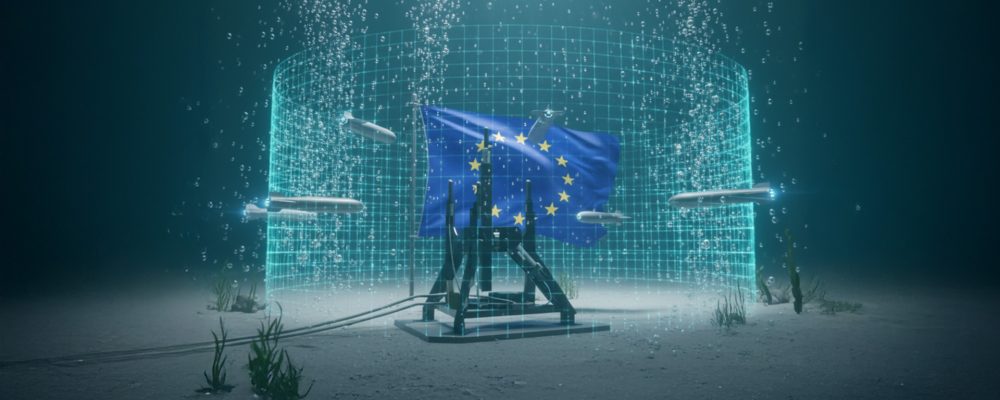
OptiBarrier adds the missing underwater layer: persistent, real‑time acoustic awareness at standoff range, so operators see threats early enough to act.
Why underwater drones are harder to spot and why “more patrols” isn’t the answer
- Poor observability below the surface. Visual, IR and surface radars do not penetrate water; classical patrol patterns (crewed or airborne drones) cannot deliver continuous subsurface coverage, especially in rough sea states. OptiBarrier was built precisely for the gap: 24/7 passive listening that never advertises its position.
- UUV communications are intermittent. Many underwater drones must surface to relay data over distance, which limits real‑time cueing and leaves windows of uncertainty. Fixed, high‑fidelity seabed listening reduces that uncertainty by keeping a continuous watch.
- Legacy “quick fixes” miss small, quiet targets. Distributed Acoustic Sensing (DAS) on existing telecom fibres is attractive on paper, but in practice loses bandwidth and sensitivity with distance and often needs long averaging windows. By the time it decides, the target has moved. OptiBarrier maintains high sampling fidelity out past 100 km and triggers in seconds, not minutes.
Meet OptiBarrier: persistent, over‑the‑horizon underwater awareness
OptiBarrier is a fibre‑optic seabed sensing solution that forms a quiet, wide‑area acoustic “net” around critical underwater infrastructure (CUI). It delivers immediate, over‑the‑horizon threat detection, 24/7, so operators gain minutes to hours of warning instead of seconds.
What it is
- Hydrophone pods (200 m and 600 m depth variants) with wide acoustic bandwidth (approximately 10 Hz to 10 kHz) and a noise floor below Sea State 0 for exceptionally clean data.
- A shore‑side Interrogation Unit (19 inch rack) that oversamples at 1 MHz, processes multiple channels in real time, and outputs digital acoustic data for downstream analytics and Command and Control systems.
- No wet‑end electronics. The wet side is fully passive, which boosts reliability and survivability; electronics live safely onshore.
What it does
- Detects and localises anomalous underwater activity, including UUVs and ROVs, divers, and anchor drags near cables and pipelines, at long range.
- Classifies objects with partner algorithms (operator in the loop today, with pathways to higher autonomy) and integrates targets and tracks into existing operations centres.
Proof point: In joint work, ELAC Sonar highlighted that scaling to many pods yields “superior situational awareness,” underlining OptiBarrier’s advantage as a multi‑node, fixed sensor grid.
The four differentiators that matter in the water
- Persistent. Air and surface drones must cycle for weather, fuel and crew. OptiBarrier listens continuously with no emissions, so it remains covert.
- Real time. High SNR and oversampling mean no long averaging delays; cues arrive while there is still time to respond.
- Range and coverage. Unlike DAS, OptiBarrier performance is not constrained by cable length; you can push sensing standoff while retaining classification‑grade bandwidth. Build meshes spanning corridors and entire exclusion zones with a single backhaul to shore.
- Reliability. With no electronics in the wet end, uptime and lifetime improve and OPEX drops due to fewer failures and less maintenance.
DAS vs. OptiBarrier: what the numbers mean operationally
- Sampling fidelity: OptiBarrier holds approximately 1 MHz sampling even at long standoff, preserving the high‑frequency features you need to sort a small UUV from benign noise. Typical DAS systems down‑shift with distance, for example from kilohertz to hundreds of hertz, sacrificing classification cues.
- Latency: OptiBarrier’s cleaner signal lets you trigger in seconds; DAS often requires tens of seconds to minutes of integration to reach a usable noise floor.
- Geometry: OptiBarrier pods are omnidirectional, giving 360 degree coverage; DAS is effectively line‑of‑cable, blind off axis, and degrades further if a legacy cable is buried.
Built to plug into your command syste
A recurring theme from customer discussions is interoperability: defence and grid operators want clean acoustic truth that slots into their C2 and analytics stacks. OptiBarrier’s interrogator outputs digital audio and data and is already being positioned for direct integration into advanced command systems through our software partners, keeping analysts “on the loop,” not buried in raw signals.
Where to deploy first
Critical Underwater Infrastructure (CUI):
- Subsea power interconnectors and export cables: detect anchor drags and stealthy interference before faults propagate.
- Offshore wind hubs and energy islands: establish exclusion zones with long‑range detection to buy response time.
- Pipelines and telecom cables: monitor approach corridors and chokepoints continuously, not only after alarms trip.
Across Europe and allied waters, policy and procurement momentum for CUI protection is accelerating via national mandates, NIS2 and CER transpositions, and Baltic and North Sea regional agreements, making persistent underwater surveillance a funded requirement rather than a nice to have. OptiBarrier’s greater than 100 km standoff and passive operation align directly with those frameworks.
A complete, low friction way to buy
OptiBarrier is delivered through a prime‑led consortium: Optics11 provides sensors and interrogators; specialist partners supply pods, analytics software and installation. Customers contract once and receive an integrated, field‑proven system. This model shortens time to mission and aligns a single team around performance and uptime.
At a glance: OptiBarrier technical highlights
- Hydrophones: 200 m and 600 m versions; approximately 10 Hz to 10 kHz band; noise floor below Sea State 0.
- Interrogation Unit: multi‑channel processing, 1 MHz oversampling, 19 inch rack; all electronics on the dry end.
- Scale: meshes with many pods; single backhaul to shore; synchronous multi‑interrogator deployments.
- Operations: immediate, over‑the‑horizon alerts; 24/7 passive monitoring; real‑time outputs ready for classification and display.
What this means for “drone walls”
Airborne drone defenses are essential but incomplete without a seabed layer. OptiBarrier turns the seabed into a silent picket line that hears threats long before they reach critical assets, then cues air, surface, and subsea responders with enough time to intercept, verify, and deter. That is how nations and asset owners close the last major gap in multi‑domain security.
Next steps
- Request a threat model session for your harbour, cable landfall, energy island, or pipeline corridor: Contact Us