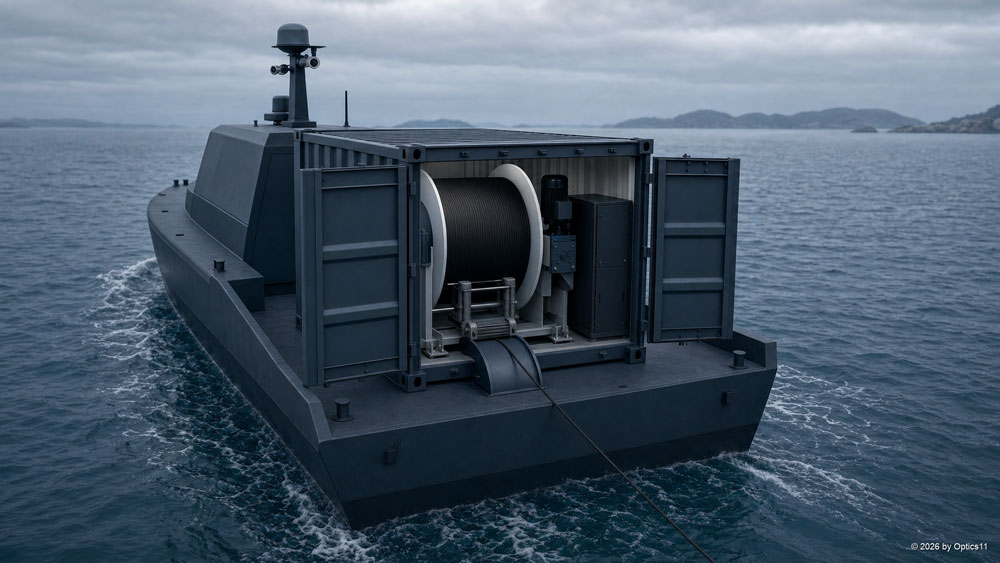

How the Hamburg Summit and NATO’s expanded presence reshape the case for seabed monitoring
The Hamburg North Sea Summit on 26 January 2026 marked a turning point for Europe’s offshore energy future. Ten countries, including the Netherlands, Germany, Denmark, Norway, Belgium, France, the United Kingdom, Ireland, Iceland, and Luxembourg, alongside the European Commission committed to accelerate offshore wind and hydrogen development while explicitly addressing a challenge that, until recently, lived in the background of energy policy discussions: the physical security of critical underwater infrastructure.
This is not an abstract concern. Over the past three years, Europe has witnessed a string of suspicious incidents targeting subsea cables and pipelines, from the Nord Stream explosions in 2022 to the Balticconnector damage in 2023 and multiple cable cuts in the Baltic Sea in late 2024. The Hamburg declaration formalises what operators and governments have increasingly recognised, that building more offshore infrastructure without addressing its protection creates systemic risk.
The new security reality: from awareness to action
The Hamburg communiqué explicitly names the threat: physical, cyber, and hybrid attacks on energy systems. Germany’s Federal Government described the summit as focused not only on affordability and interconnection but also on “increased security in the North Sea and the High North.” The European Commission has meanwhile published a Joint Communication on submarine cable security that structures resilience around four pillars: prevent, detect, respond, and deter.
The operational response is already taking shape. NATO’s Combined Task Force Baltic and the Dutch-led SNMG1 flotilla now patrol regularly to deter sabotage. Just days before the Hamburg Summit, news broke that the ten North Sea nations will conduct joint military exercises and deepen NATO cooperation specifically to protect electricity cables, transformer platforms, gas pipelines, and data links. The Dutch frigate Zr. Ms. Tromp has spent months as the flagship of NATO’s rapid-response group in the North Sea and Baltic, tracking vessels that linger suspiciously near critical infrastructure.
Yet naval patrols face inherent limitations. As former NATO Secretary-General Jens Stoltenberg acknowledged, there is no way to maintain continuous NATO presence along thousands of kilometres of undersea infrastructure. Ships are expensive to deploy, constrained by weather windows, and reactive by nature, they can respond once something happens, but cannot provide persistent surveillance across vast seabed areas.
The detection gap and why it matters
This is where the Hamburg Summit’s emphasis on security as part of the energy system design, rather than an afterthought, becomes operationally significant. Cross-border interconnectors, hybrid projects linking wind farms to multiple countries, and offshore hydrogen infrastructure multiply the nodes and routes that require protection. The expansion is happening fast: the North Seas Energy Cooperation aims to unlock massive renewable potential through regional grid integration. Every new cable and every new platform extends the perimeter that must be monitored.
Detection before damage is the critical capability gap. Naval assets can intercept suspicious vessels when alerted, but without persistent underwater awareness, the first indication of a problem may be a severed cable. The EU’s cable security framework explicitly emphasises detection capacity so that threats can be identified and anticipated early. The question becomes: how do you achieve meaningful detection over areas measured in thousands of square kilometres, at a cost that scales with the infrastructure buildout rather than against it?
Where OptiBarrier fits: persistent, scalable, low-OPEX monitoring

OptiBarrier addresses this gap with a fibre-optic seabed hydrophone network designed for 24/7 acoustic surveillance around critical underwater infrastructure. The core proposition is straightforward: real-time, over-the-horizon threat detection that does not degrade with distance and does not require constant vessel presence.
The technical architecture delivers three operational advantages that align directly with the Hamburg security agenda.
Extended detection range without resolution loss. OptiBarrier maintains high-fidelity acoustic performance beyond 100 kilometres from shore, meaning threats can be detected while there is still time to respond, rather than at the moment of impact. The system’s kHz-range resolution supports acoustic fingerprinting to classify divers, unmanned underwater vehicles, surface vessels, and submarines, providing actionable information rather than ambiguous alerts.
Passive, all-optical design. With no electronics in the wet end, OptiBarrier eliminates the failure modes that drive offshore maintenance costs. The sensor network is fully passive, no active pings, no electromagnetic emissions, no seabed power requirements, which extends component life beyond without scheduled service. This reliability translates directly into reduced vessel mobilisations and lower lifecycle OPEX.
Scalable coverage architecture. A single cable backhaul can support a network of hydrophones covering wide areas around multiple assets. As interconnection expands under North Seas Energy Cooperation planning, security monitoring can expand with it, without multiplying standalone systems or patrol requirements for each new route.
Aligning security investment with infrastructure growth
The Hamburg Summit was clear that offshore energy must be clean, independent, and affordable. Affordability depends on managing total cost of ownership, including security. A monitoring approach that generates frequent false alarms, requires constant maintenance, or fails to provide sufficient detection range creates hidden costs that compound over the infrastructure’s lifetime.
OptiBarrier’s value is that it makes underwater security operationally sustainable at scale. By providing persistent, high-resolution acoustic awareness across wide areas with minimal ongoing intervention, it allows operators and governments to meet the detect pillar of the EU’s resilience framework without the OPEX burden of continuous active patrols or frequent sensor replacement.
The Hamburg commitments and expanded NATO presence represent a step-change in how Europe approaches offshore infrastructure protection. But patrols and response forces address only part of the problem. Persistent detection, knowing what is approaching before it reaches critical assets, is the foundation that makes everything else effective.
For operators planning cross-border projects and governments coordinating regional security, the question is no longer whether underwater surveillance is needed, but which approach delivers reliable, affordable protection at the scale the North Seas buildout demands.
OptiBarrier delivers immediate, over-the-horizon threat detection around critical underwater infrastructure. Contact our Underwater Security Specialists or learn more at optics11.com/underwater-security/seabed-monitoring.