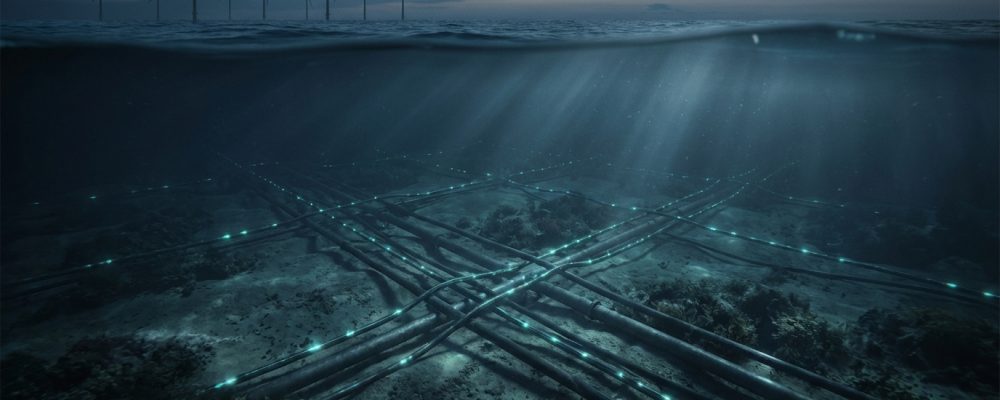
Submarine data cables carry 99% of intercontinental internet traffic. When one gets damaged, it is not just a telecom problem. It is a system-level risk for business continuity, public services, and entire economies.
The European Commission clearly agrees. On 5 February 2026, it took a major step to strengthen Europe’s cable resilience with new guidance, new funding, and a clear signal that monitoring and surveillance are now core requirements, not optional extras.
Here is what was announced, why it matters, and where OptiBarrier fits.
What the Commission announced
The 5 February package contained three linked actions:
A Cable Security Toolbox setting out risk-mitigating measures for submarine cable resilience. A list of Cable Projects of European Interest (CPEIs) to guide strategic investment. And an amendment to the Connecting Europe Facility (CEF) Digital Work Programme allocating €347 million to strategic cable projects, including a dedicated €20 million call for adaptable repair modules stationed at ports and shipyards to restore cable services faster.
That repair call is notable. It means the EU is not just talking about prevention. It is putting money behind faster recovery too.
The policy context
These announcements build on a sequence of EU actions over the past two years.
Recommendation 2024/779 set out coordinated actions for submarine cable security at national and EU level. The EU Action Plan on Cable Security, adopted on 21 February 2025, framed a full resilience cycle covering prevention, detection, response and recovery, and deterrence. And in 2025, an expert group agreed an EU-wide mapping and coordinated risk assessment approach covering capacity, technical characteristics, ownership, incidents, landing sites, and threats across both physical and cyber domains.
Executive Vice-President Henna Virkkunen put it clearly in 2025: agreeing on infrastructure mapping and risk assessment is the first building block in implementing the EU’s cable security plan.
Inside the Cable Security Toolbox
The toolbox was finalised in January 2026 and translates the risk assessments into ten actionable measures, grouped as strategic and technical.
Several themes stand out.
The toolbox calls for stronger governance and legal protections aligned with international standards. It pushes for better coordination between industry, member states, and international bodies including NATO. It emphasises the need for enhanced monitoring and surveillance, explicitly naming technologies like DAS, SMART cables, and OTDR for real-time detection along cable routes. And it addresses repair readiness, including vessel modernisation, standardised spares, and workforce development to cut outage durations.
In short: the EU sees submarine cable resilience as a system of systems. Governance, planning, monitoring, and repair capacity all have to work together.
Why monitoring is now a baseline requirement
The most practical shift in the toolbox is the weight it gives to detection.
The document calls out the value of continuous surveillance and advanced detection systems to prevent damage, identify suspicious activities, and enable rapid intervention. It pairs operational measures like AIS/VMS vessel tracking with technical systems that can detect real disturbances along cable routes.
The logic is straightforward. If you only discover a problem at the moment of failure, your options are limited to repair and rerouting. If you can detect and classify a threat early, whether that is suspicious vessel behaviour, anchor drag, or approaching underwater activity, you create response time. And response time is what separates effective underwater security from reactive damage control.
Where OptiBarrier fits
This is the gap OptiBarrier is built to fill.
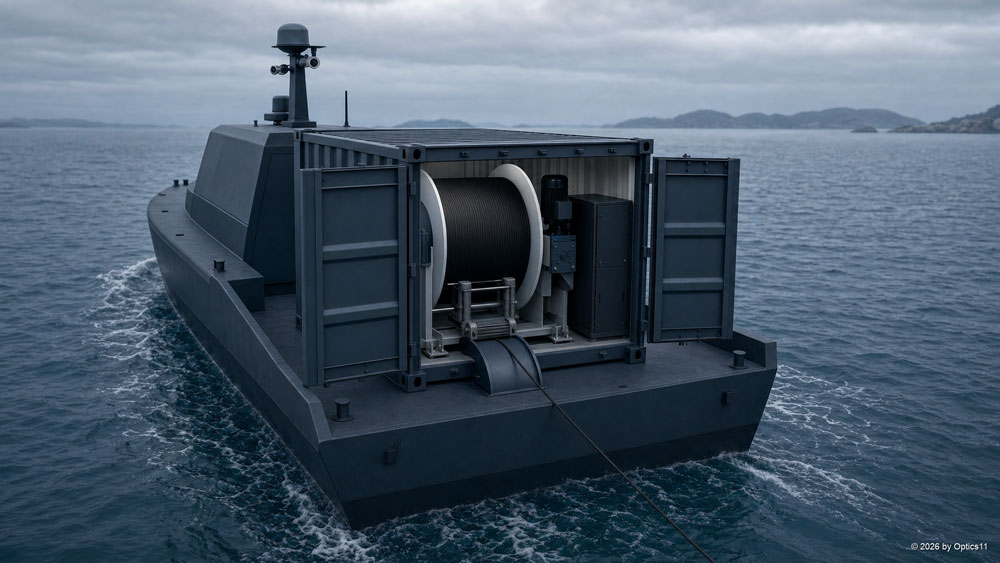
OptiBarrier turns an optical fibre line into a persistent underwater security barrier, providing real-time situational awareness over long distances with no electronics in the wet end.
At its core, it is a fibre-optic seabed sensor network combining passive, high-sensitivity hydrophones with shore-based interrogation. It enables over-the-horizon detection deployable beyond 100 km and continuous tracking of surface and subsurface activity.
The attributes that matter most in the context of the toolbox:
Passive architecture, no wet-end electronics. That means continuous, covert 24/7 operation and fewer failure points in the water.
High-fidelity sensing for classification. Linear response across 10 Hz to 10 kHz, with system self-noise below Sea State 0. This is not just about knowing something is there. It is about knowing what it is.
Long-range performance. OptiBarrier maintains a constant 1 MHz sample rate even beyond 100 km of fibre, so coverage does not degrade over distance.
Decision-ready outputs. Partner software stacks deliver detection, identification, classification, and integration into command-and-control systems.
The result is monitoring that goes beyond alerting after the fact. OptiBarrier is designed to provide the earlier awareness and classified threat information that operators, navies, and infrastructure owners need to act before damage occurs.
Practical alignment with the toolbox
There are several realistic scenarios where OptiBarrier directly supports the resilience approach the EU is now mandating.
Cable route early warning. Telecom infrastructure operators need to know about risks like dragged anchors before they cause damage and, when intentional damage is suspected, need the ability to identify culprits for deterrence purposes. OptiBarrier enables offshore placement that creates reaction time before a threat reaches the asset.
Cable landing corridor protection. The EU’s risk work specifically considers threats against cable landing sites, including beach manholes and landing stations, and encourages monitoring as a resilience measure. OptiBarrier’s wide-area monitoring capability, enabled by long-range fibre links and passive pods, is particularly relevant in these near-shore, high-risk zones where distinguishing benign from threatening activity is essential.
Complementing repair readiness. The €20 million repair call focuses on faster restoration after incidents. But repair readiness works best when paired with fast incident detection and localisation. OptiBarrier provides the early detection and tracking that reduces uncertainty and speeds up operational decision-making.
Meeting regulatory expectations for offshore infrastructure. Offshore installation managers face growing regulatory pressure to monitor their assets and demonstrate they are taking underwater threats seriously. They want a system that operates quietly in the background and integrates with naval authorities for alerts. That aligns directly with the toolbox’s emphasis on coordinated monitoring and practical resilience.
The bottom line
The European Commission’s February 2026 announcement makes something explicit that has been building for years: submarine cable protection is now a strategic security and resilience priority, backed by policy guidance, prioritisation mechanisms, and €347 million in concrete funding.
For infrastructure owners and public authorities, the direction is clear. Resilience must span prevention, detection, response and recovery, and deterrence. Monitoring and surveillance are baseline requirements for what “resilient infrastructure” means going forward.
OptiBarrier fits naturally into this picture. It enables persistent, passive underwater security monitoring and early warning over long distances, creating the reaction time that operators, navies, and infrastructure owners need to prevent incidents or limit their impact.
Talk to our Underwater Security Experts here.