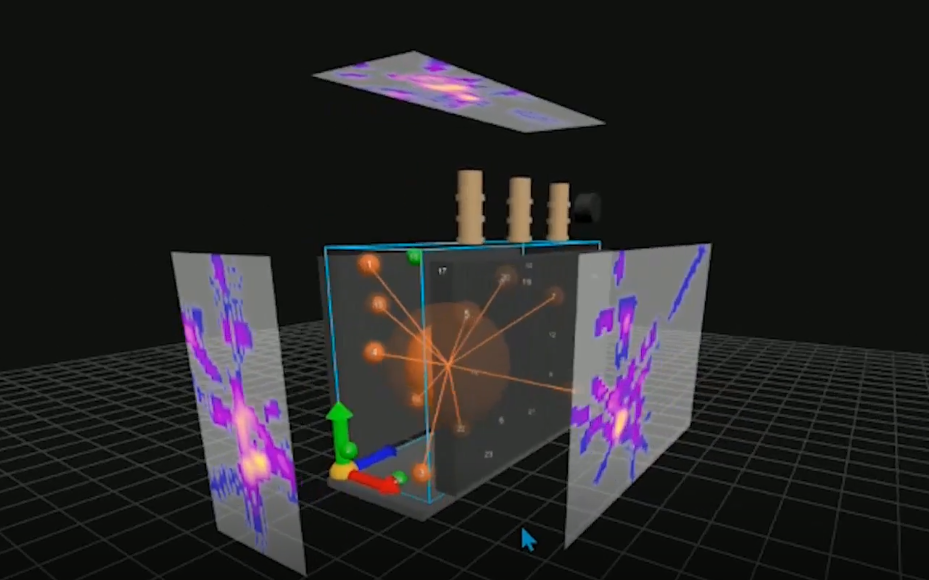

The underwater cables, pipelines, and offshore energy connections that power modern Europe are essentially unmonitored. The regulations say that must change. The technology is finally ready.
In September 2022, the Nordstream explosions delivered a wake-up call that reverberated across every European capital: the vast network of subsea infrastructure that underpins our energy supply, data connectivity, and economic security is dangerously exposed.
Since then, the picture has only sharpened. Russian research vessels documented mapping North Sea infrastructure. Shadow fleet operations raising constant concern in the Baltic. And the hybrid threat, operating in the grey zone between peace and war, moving from theoretical risk to operational reality.
Europe has responded with regulation. But the technology gap remains.

The Problem: Episodic Coverage in a Persistent Threat Environment
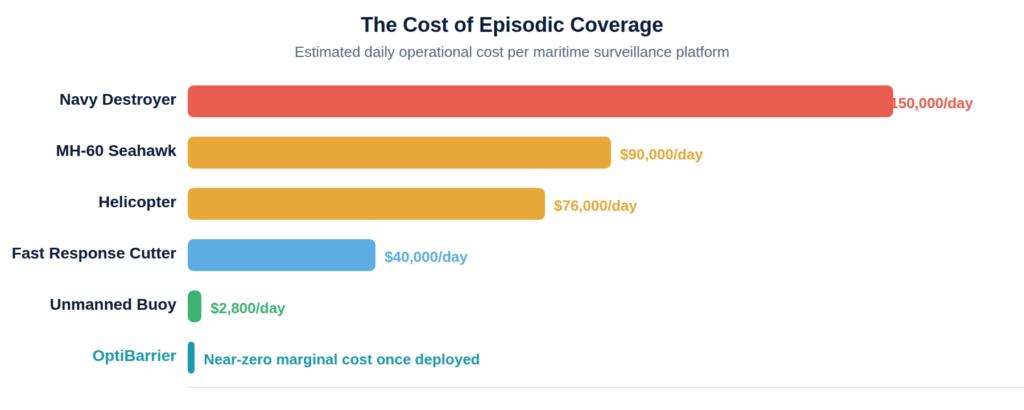
Here is the uncomfortable truth defence planners and infrastructure operators are confronting: we do not have persistent seabed monitoring at scale. What we have is episodic coverage. Naval patrols that operate for hours, unmanned surface vessels that survey for days, autonomous underwater vehicles that run until their batteries die.
Between those episodes, the seabed is blind.
“Surveillance coverage is measured in hours or days, leaving prolonged sensing gaps. Seabed protection increasingly depends on continuous presence in remote maritime areas.” The challenge as framed by industry leaders at recent defence conferences
This matters because the threats to subsea infrastructure are not episodic. A combat diver, a remotely operated vehicle, or a ship dragging an anchor does not arrive on schedule. The gap between the last patrol and the next one is precisely the vulnerability that adversaries exploit.
A Different Architectural Approach
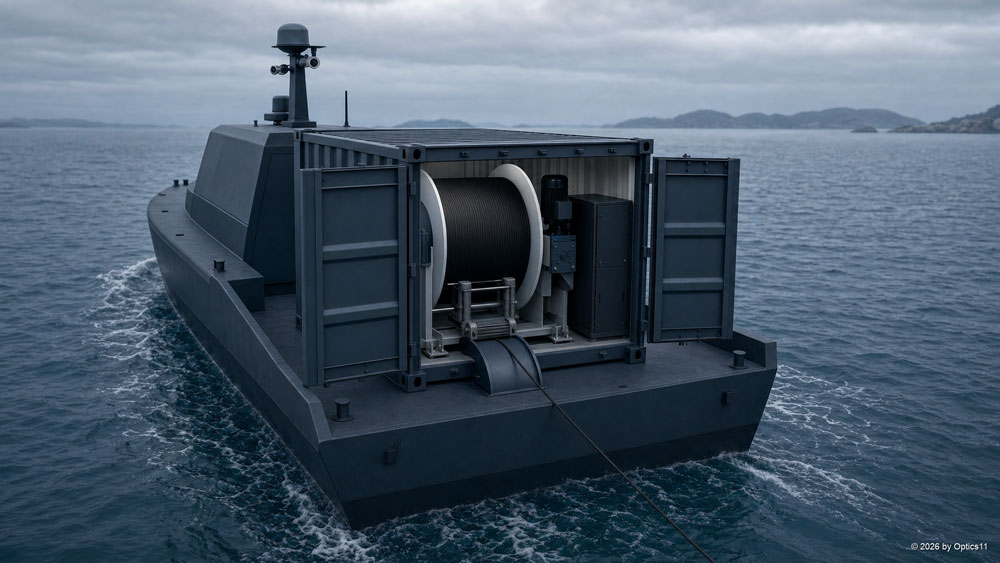
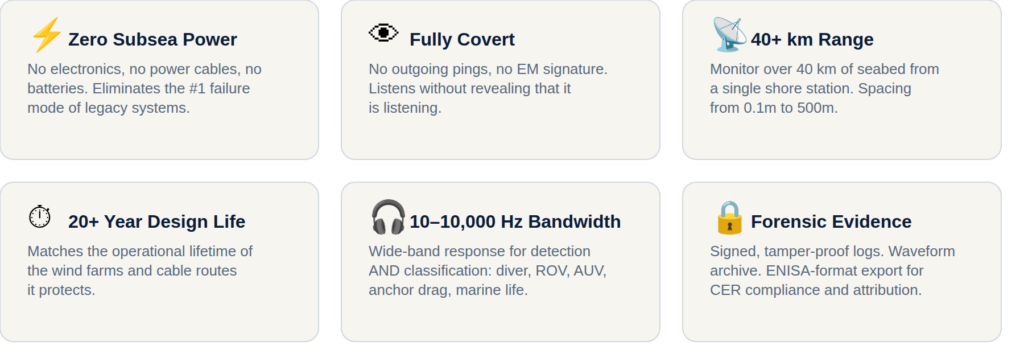
Rather than adapting existing technologies to a mission they were not designed for, we went back to first principles. The result: an all-optical subsea monitoring system built on fibre-optic hydrophones. Discrete acoustic sensors connected by a fibre-only backbone, with no electrical components on the seabed.
No electronics means no corrosion, no power cables running to the seabed, no electromagnetic signature that could betray the system’s presence, and no batteries that limit operational life. The system is entirely passive and covert. It listens without revealing that it is listening.
From a single shore-based interrogation unit, OptiBarrier can monitor step-out distances exceeding 40 kilometres, with hydrophone separations configurable from 0.1 metres to 500 metres. The acoustic bandwidth (10 to 3,000 Hz with a flat response) provides the signal quality needed not just for detection, but for classification: distinguishing a diver from an ROV from an anchor drag from marine life.
And because there are no wet-end electronics to fail or maintain, the system is designed for a service life of more than 20 years, matching the operational lifetime of the offshore wind farms, pipelines, and cable routes it is built to protect.
Not a Standalone Solution. A Building Block.
The era of standalone systems is ending. Navies are shifting to system-of-systems architectures where capability is disaggregated across connected platforms. The PESCO CSIP programme explicitly requires a modular, layered approach. The EDF’s latest call topics describe an all-domain situational awareness chain running “from seabed to space.”
OptiBarrier is designed for this world. It is not a competing platform. It is the persistent seabed sensing layer that feeds data into the broader architecture. Its open API enables integration with command-and-control systems. Its data output is formatted for underwater maritime situational awareness (UMSA) fusion.

In practical terms, OptiBarrier works alongside the USVs, AUVs, and patrol assets that navies and operators are already deploying. Those mobile platforms are the response layer. OptiBarrier is the sensing layer that tells them where to go. The persistent tripwire that cues the dynamic response.
From Detection to Attribution
Detection alone is no longer sufficient. When a subsea cable is damaged, the question is not just “what happened?” It is “who did it, and can we prove it?”
This attribution challenge has legal, regulatory, and strategic dimensions. Under the CER Directive, operators must file an incident notification within 24 hours. Insurers require evidence. Governments need forensic-quality data for diplomatic response. In the grey zone of hybrid warfare, attribution is the difference between a security incident and a geopolitical event.
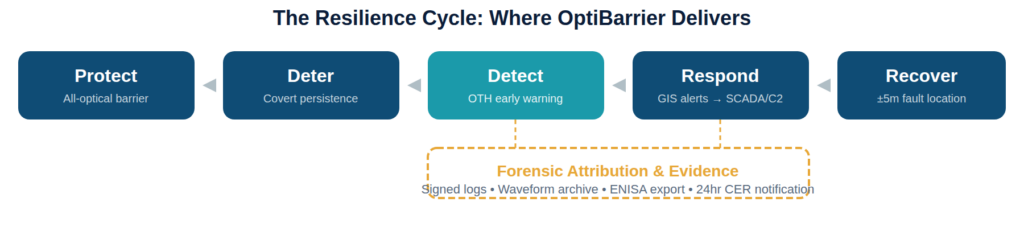
OptiBarrier is designed with this reality in mind. Every detection generates a timestamped, geo-tagged event record with the full acoustic waveform archived for forensic review. Event logs are cryptographically signed and tamper-proof, exportable in ENISA-standard formats. The goal is not just to know that something happened on the seabed. It is to know what, where, when, and by whom.
The Dual-Use Opportunity
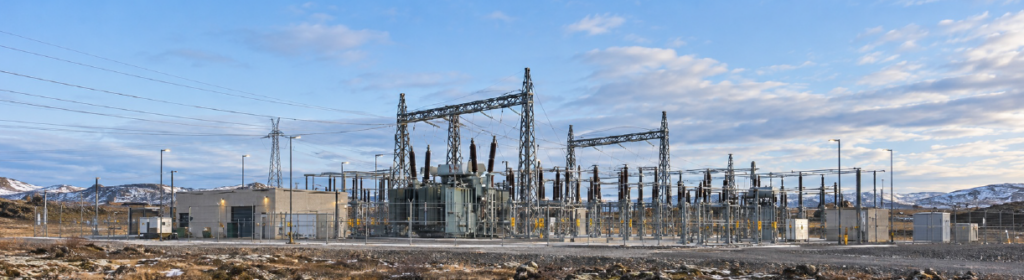
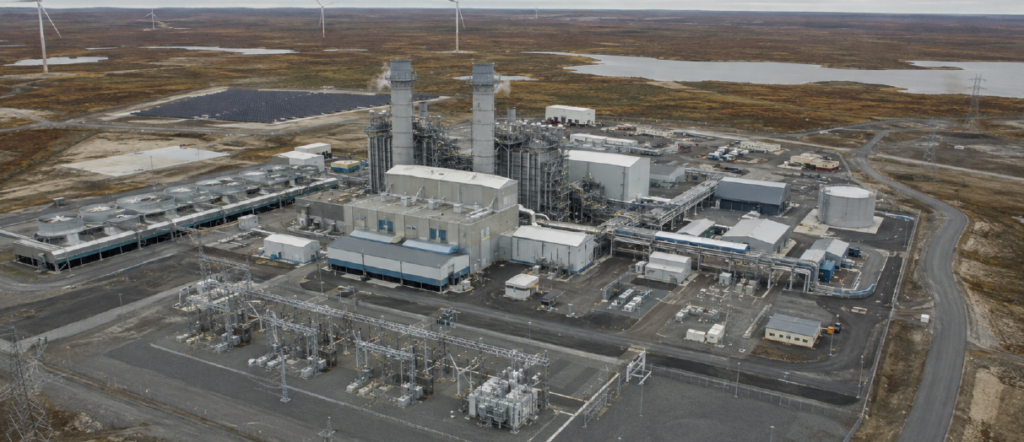
There is a growing recognition across Europe that critical commercial infrastructure and national defence are converging. Offshore wind farms are not just energy assets. They are strategic infrastructure. Subsea telecom cables are not just data pipes. They are arteries of the digital economy.
The same OptiBarrier array that protects an offshore wind farm’s export cable for CER compliance simultaneously provides acoustic surveillance data that feeds national defence situational awareness. The investment in commercial compliance becomes the foundation for a public-private partnership where defence agencies co-invest in shared capability.
One system. Two mandates. One investment.
Scaling from Port to Coastline
OptiBarrier is built on a modular architecture that scales without system redesign. Start small, prove value, expand. No rip-and-replace.
An operator can start small, prove the concept in a harbour environment, and scale up as requirements evolve.
The Regulatory Clock Is Ticking
The CER Directive creates a compliance timeline that infrastructure operators cannot afford to ignore. Given that procurement cycles for subsea systems run 12 to 18 months, operators who begin planning after designation will already be behind.
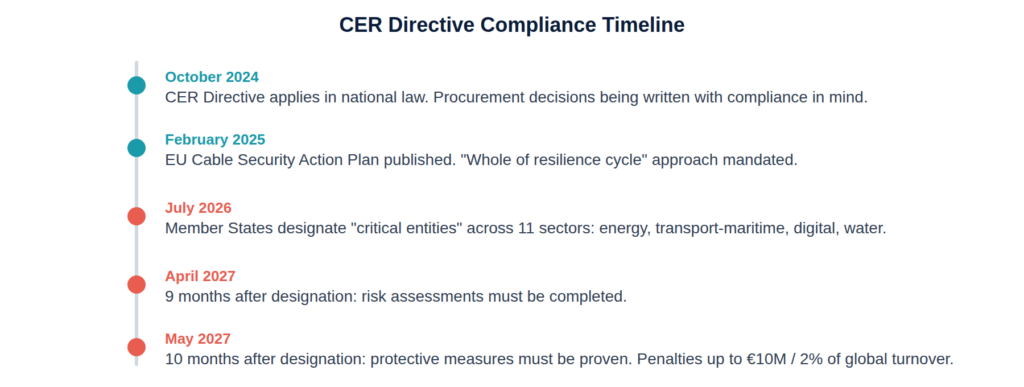
OptiBarrier is CER-ready from day one. Automated incident notification, audit-ready evidence logs, and resilience-pack templates that pre-populate regulatory reporting with sensor data.
Looking Ahead
The seabed security landscape is evolving rapidly. AI-driven classification is improving with every deployment. Software partners across Europe are developing increasingly sophisticated acoustic processing capabilities. New integration opportunities are expanding what a persistent seabed sensing layer can contribute to the broader defence architecture.
At Optics11, we believe the foundations matter most. A sensing layer that operates reliably for decades, that produces forensic-quality data, that integrates openly into any architecture, and that scales from a harbour to a coastline. That is the infrastructure on which everything else is built.
The seabed has been blind for too long. It is time to start listening.
Ready to close the sensing gap? Whether you’re protecting offshore energy assets, securing telecom landing points, or building a layered CSIP architecture, contact the OptiBarrier team at optics11.com/contact